- Date :18 Jun, 2026
- Category : Inorganic Chemistry
Chemical Analysis Without Instruments: Just Measure the Length!
In chemistry experiments, “colorimetric analysis” is a method used to determine the amount of a substance based on the intensity of its color. Typically, this requires specialized instruments like spectrophotometers to numerically measure color intensity. However, what if you could accurately measure the concentration of a substance without any special equipment, using only common tools? Professor Kaneta’s research group has developed an innovative “instrument-free” analytical method that does exactly that.
How a “Colored Band” in Silica Gel Reveals Concentration
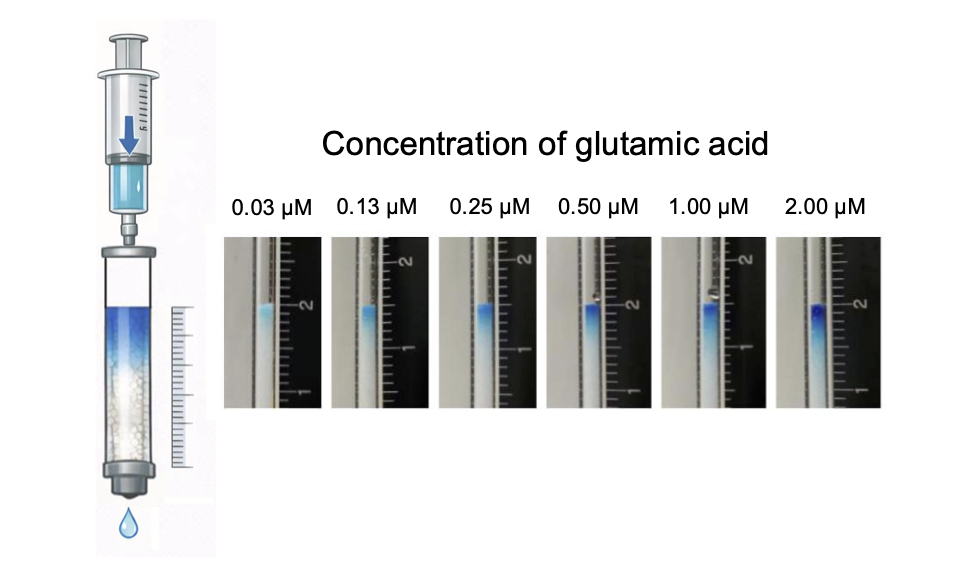
The secret to this new analytical method lies within a small tube called a “silica gel column.” Silica gel is a common material known for its ability to adsorb impurities from water. In this method, a solution containing the substance to be analyzed (analyte) is passed through the silica gel column. If the analyte is a colored compound (or reacts with a chromogenic agent to become colored), it gets adsorbed onto the silica gel, forming a distinct colored band. Remarkably, it was discovered that the length of this colored band is directly proportional to the concentration of the analyte in the solution. This means you can determine the substance’s concentration simply by measuring the length of the band with a ruler!
Easy Measurement for Everything from Iron Ions to Amino Acids
To validate the practicality of this principle, the research group tested it with several substances. For instance, in experiments analyzing trace amounts of iron ions (Fe2+) found in tap water, the method achieved a sensitivity comparable to conventional methods that use expensive instruments, accurately measuring iron ion concentrations. Furthermore, the approach was extended to measure “glutamic acid,” an important amino acid in our bodies. In this case, the proposed method demonstrated superior sensitivity compared to existing analytical techniques. A significant advantage of this technology is its ability to preconcentrate the target substance within the column, making it easier to detect even very small amounts.
Towards a Future of Accessible Chemical Analysis, Anywhere, Anytime
This research demonstrates the potential for highly sensitive and quantitative chemical analysis through simple “distance measurement,” without the need for special equipment or extensive expertise. This opens up possibilities for easy chemical analysis in various applications, such as monitoring environmental pollutants, ensuring food quality, and even in medical diagnostics. “Analytical Chemistry” is the field that makes everything around us “visible,” revealing the properties and quantities of substances. If you’re interested in uncovering the scientific principles hidden in everyday phenomena and creating new technologies, we invite you to explore the world of analytical chemistry.
Reference
- Sychanh Phonxayxiong, Takashi Kaneta (2026) “Instrument-free quantitative colorimetric analysis using adsorption-band length in a packed silica gel column.” Talanta: The International Journal of Pure and Applied Analytical Chemistry, 129728. DOI: 10.1016/j.talanta.2026.129728
Learn more about Prof. Takashi → Analytical Chemistry Laboratory