- Date :11 Jul, 2026
- Category : Physical Chemistry
In a single glass of water, billions upon trillions of molecules are constantly in motion. To our eyes, water appears to be nothing more than a transparent liquid. At the molecular level, however, it forms a complex world in which molecules continually attract and repel one another.
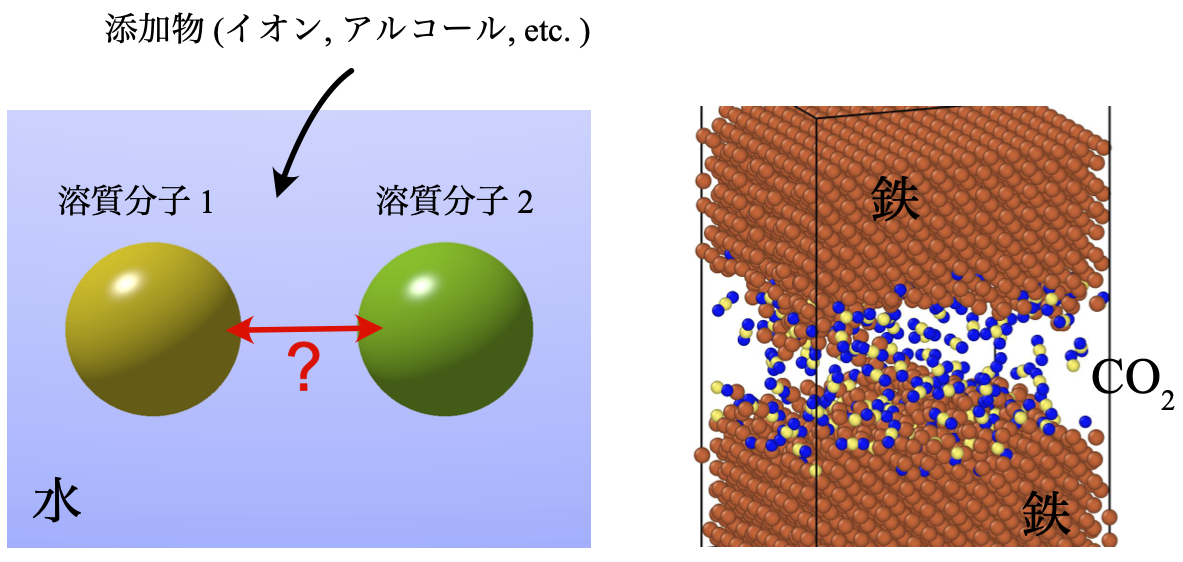
My research uses theory and computer simulations to understand these “invisible forces between molecules.”
This research has applications in a wide range of familiar technologies, including food, pharmaceuticals, polymeric materials, and batteries.
Why Does Adding Salt Make a Difference?
For example, adding table salt to water can cause carbonated drinks to lose their fizz more quickly or proteins to precipitate. It is also well known that oil does not dissolve in water, but adding salt changes just how insoluble it is. Although phenomena like these have been known for more than a century, one question remains incompletely answered even today:
Why do different types of salt have different effects?
We developed a theory that considers water, ions, and solutes simultaneously, allowing us to calculate:
- what kinds of ions
- to what extent
- cause molecules to attract or repel one another.
Furthermore, we demonstrated that
there is a relationship, expressible by a simple equation, between solubility and the attractive forces between molecules.
This is a previously unknown theoretical result.
What Happens When Water and Alcohol Are Mixed?
Even more intriguing phenomena occur when water is mixed not only with ions but also with another solvent, such as alcohol.
Some solute molecules prefer alcohol, while others prefer water.
As a result, molecules of the same type can become much more likely to aggregate. I developed a thermodynamic theory to explain this phenomenon.
This theory suggests that phenomena previously studied separately may be understood within a single conceptual framework, including:
- cononsolvency, in which a polymer suddenly collapses
- depletion interactions
- effective interactions in mixed solvents.
Investigating Friction with Computers
In recent years, in addition to theoretical research, I have been working on molecular dynamics simulations of friction.
Although friction is taught in high-school physics, it is an extremely complex phenomenon involving many interconnected processes, including chemical reactions at surfaces, plastic deformation, and heat dissipation. It therefore remains an active area of research. In automobiles and electric vehicles, for example, minimizing friction and wear between contacting metal components is important.
Experiments alone, however, cannot easily reveal what kinds of chemical reactions occur among atoms on metal surfaces.
We therefore use computers to simulate the motion of individual atoms.
In a recent study, we revealed at the atomic level how sliding iron surfaces against each other in carbon dioxide (CO₂) produces a carbon-rich protective layer, known as a tribofilm, that substantially reduces friction and wear. My main contribution to this work was conducting reactive molecular dynamics simulations to analyze the reaction process.
Research Bridging Chemistry and Physics
My research seeks to understand the invisible molecular world by combining chemistry and physics.
For anyone who enjoys asking “Why does that happen?” about everyday phenomena, this is a fascinating field of research.
References
- Ryuichi Okamoto and Kenichiro Koga, Theory of Gas Solubility and Hydrophobic Interaction in Aqueous Electrolyte Solutions, Journal of Physical Chemistry B (2021). DOI: 10.1021/acs.jpcb.1c08050
- Ryuichi Okamoto, Theory of effective interactions between identical and different non-ionic solutes in a binary solvent, Physica A (2024). DOI: 10.1016/j.physa.2024.130033
- Julio A. Cao‐Romero‐Gallegos, Seungjoo Lee, Cagatay Yelkarasi, Leonardo Farfan Cabrera, Ryuichi Okamoto, Hitoshi Washizu, and Ali Erdemir, On the Friction and Wear Mechanisms of Electrified Steel Contacts in CO₂ : Unveiling the Role of Carbon‐Rich Tribofilms Under Dry Sliding Conditions, Advanced Materials Interfaces (2026). DOI: 10.1002/admi.70579
Learn more about Prof. Okamoto → Theoretical Physical Chemistry Laboratory