- Date :23 Jun, 2026
- Category : Inorganic Chemistry
A New Material That Glows Red Under UV Light—with a Built-in Switch
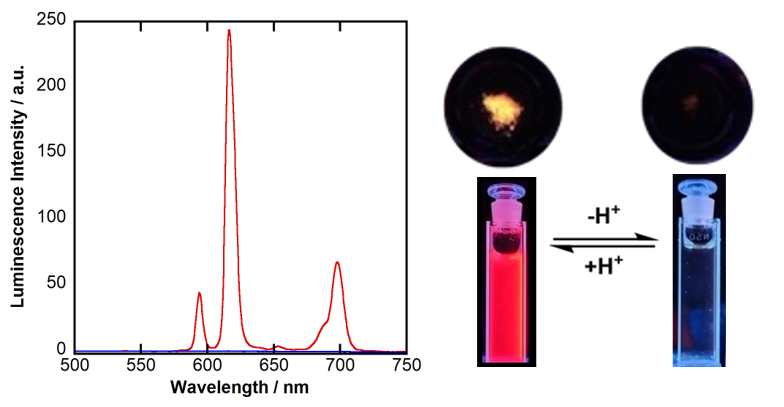
The newly developed europium(III) complex in this study exhibits bright, vivid red photoluminescence upon UV irradiation. This emission can be completely quenched by heating the crystalline sample or adding a base to the solution. Furthermore, exposing the heated solid to hydrogen chloride vapor or returning the solution to acidic conditions allows photoluminescence to be switched ON and OFF repeatedly.
What Are Metal Complexes?
A “metal complex” is a compound in which inorganic molecules or ions—such as water, ammonia, or chloride ions—or organic molecules such as carboxylic acids bind to a metal ion through coordinate bonds using their lone electron pairs. Depending on the metal ion and ligands involved, complexes can adopt a wide variety of structures with different coordination numbers and spatial arrangements. Metal complexes are expected to find applications as catalysts in organic synthesis, anticancer agents, luminescent materials, sensors, and more, and research on the synthesis of new complexes remains highly active today.
Complexes That Change Properties in Response to the Environment
Professor Suzuki’s research group has been working on the synthesis of metal complexes whose properties—such as coloration and luminescence—change in response to external environmental factors including temperature, pressure, surrounding gas atmosphere, and solution acidity. In this study, the group focused on europium(III) ions, which exhibit characteristic red emission, and synthesized a new europium(III) complex whose photoluminescence can be clearly switched ON and OFF in response to external stimuli. They then investigated the mechanisms underlying this emission and quenching behavior.
Freely Switching Photoluminescence ON and OFF
Photoluminescence spectra of the obtained compound revealed characteristic red emission of europium(III) ions in both the solid state and acetonitrile solution. However, heating the crystalline solid or adding a base to the solution completely quenched this distinctive emission. Subsequently, exposing the non-emissive solid to hydrogen chloride vapor or adding acid to the solution restored the original luminescence. In other words, using this europium(III) complex, the group succeeded in switching photoluminescence ON and OFF through changes in external conditions.
Unraveling the Switching Mechanism
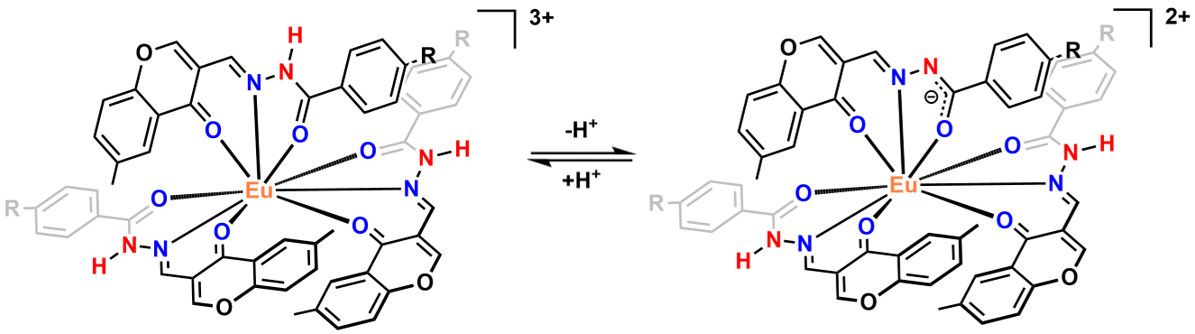
The mechanism underlying this photoluminescent response is based on the deprotonation and reprotonation of N–H sites in the organic ligand coordinated to the metal ion. Hydrogen ions (H⁺) are released upon treatment with a base or heat (as HCl vapor in the solid state), converting the complex to its deprotonated form; exposure to acid vapor or addition of acid converts it back to the protonated form. Accompanying these structural changes, the energy levels of the ground state (before light absorption) and the excited state (after light absorption) are altered, thereby controlling the switching of photoluminescence.
Toward Applications in Sensors and Optical Materials
The photoluminescence switching mechanism identified in this study is expected to guide molecular design for next-generation sensors and optical materials such as security inks. “Coordination chemistry” is the field devoted to designing and synthesizing molecules whose properties change in response to external stimuli, enabling us to control the behavior of materials around us and create new functional materials. If you are interested in molecules that respond to changes in light, temperature, or acidity, we invite you to explore the world of coordination chemistry.
Reference
- A. Kamei, D. Saito, K. Takahara, K. Nose, H. Okamoto, M. Yoshida, M. Kato, T. Suzuki (2026) “Switchable photoluminescence of europium(III) complexes with chromonylhydrazones” Chemical Communications, 2026, 62, 13133–13136; DOI: 10.1039/D6CC01278G
Learn more about Prof. Suzuki → Coordination Chemistry Laboratory