
- Date :23 Jun, 2026
- Category : Physical Chemistry
A Key Material for Making Hydrogen from Sunlight
Photocatalysts use light energy to split water into hydrogen and oxygen, and they are attracting worldwide attention as a technology for producing clean hydrogen directly from sunlight. When light hits a photocatalyst, electrons and holes are generated, and both play essential roles in producing hydrogen and oxygen.
In real materials, however, crystal defects are unavoidable. If electrons or holes are trapped at these defects, they can become inactive before they contribute to water splitting. For holes in particular, the widely accepted “small polaron” model for ultraviolet-responsive materials such as titanium dioxide predicts that holes become deeply trapped at oxygen sites and strongly distort the surrounding lattice.
By contrast, next-generation visible-light photocatalysts, including oxynitrides and complex oxides, often show trapped holes as sharp absorption peaks near the band edge. This behavior could not be explained by the conventional model and had remained a long-standing mystery.
Experiments to Solve the Mystery
Prof. Akira Yamakata at Okayama University, Assistant Prof. Junie Jhon M. Vequizo at Shinshu University, and Special Honorary Prof. Kazunari Domen and their collaborators used time-resolved transient absorption spectroscopy to track the motion of holes generated by light irradiation.
Their systematic study began with tantalum oxide (Ta2O5), then progressed through oxynitrides with gradually increasing nitrogen content (TaON and Ta3N5), and further to perovskite-type oxynitrides (CaTaO2N, SrTaO2N, and BaTaO2N). They also integrated findings from representative visible-light complex oxides such as WO3, BiVO4, and Fe2O3 to clarify the underlying mechanism of hole trapping.
Three Types of Hole Trapping
As a result, hole trapping in photocatalysts could be classified for the first time into three types (Type A/B/C).
Type A (ultraviolet-responsive oxides: TiO2, Ta2O5, etc.)
Because oxygen ions have low polarizability, localized holes strongly distort the surrounding lattice and form deep trap states. This corresponds to the conventional small-polaron model and appears as broad optical absorption.
Type B (visible-light-responsive oxynitrides: TaON, Ta3N5, BaTaO2N, etc.)
Nitrogen ions are more polarizable than oxygen ions and electronically screen the positive charge of the hole, greatly suppressing lattice distortion. The hole therefore remains in a shallow trap state near the band edge and appears as a sharp absorption peak.
Type C (visible-light-responsive complex oxides: WO3, BiVO4, Fe2O3, etc.)
Strong hybridization between metal d orbitals and oxygen 2p orbitals spreads the hole over multiple metal-oxygen bonds. This spatial delocalization suppresses lattice distortion and, like Type B, produces shallow trap states.
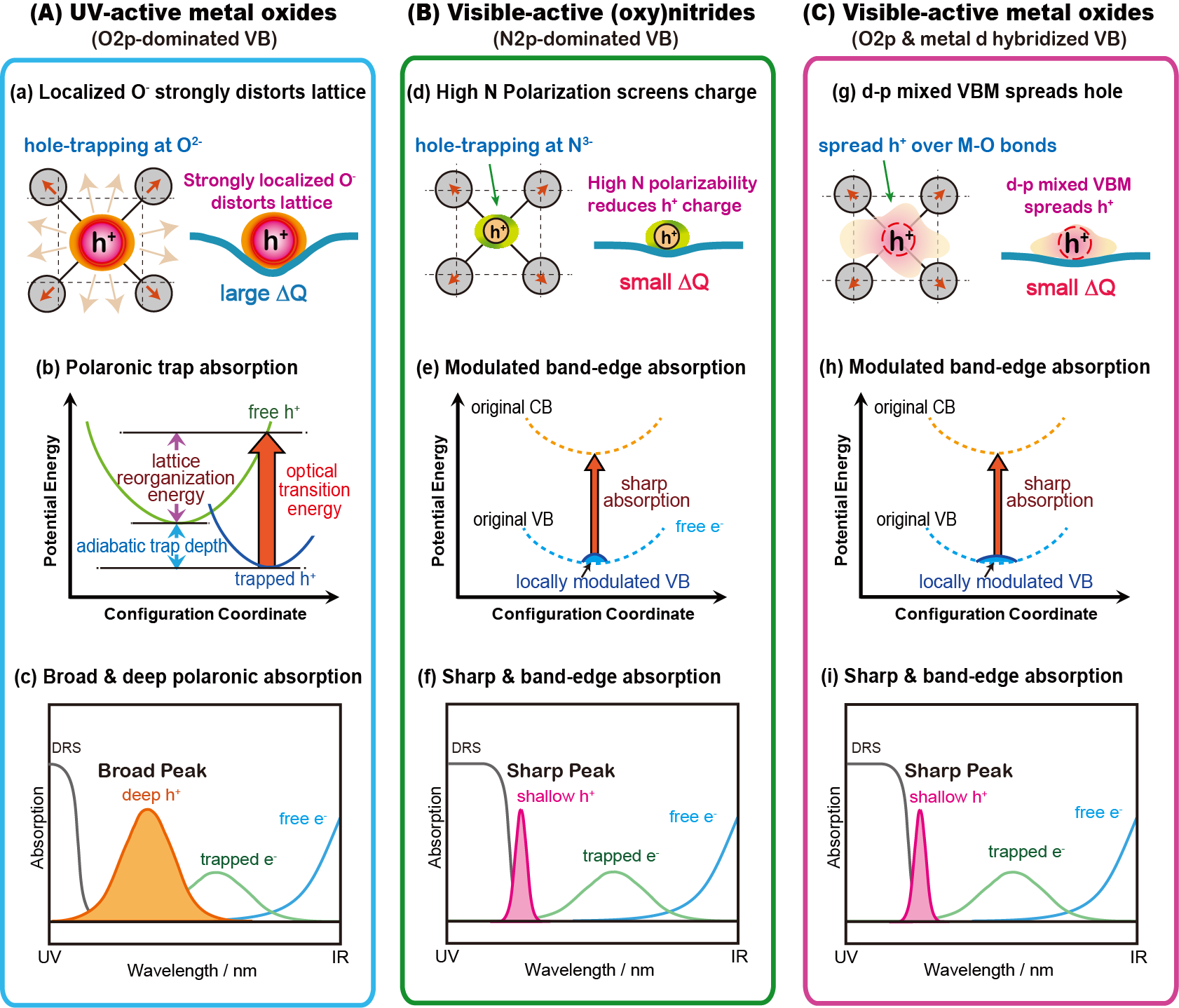
Figure 1. Unified mechanism of hole trapping. In ultraviolet-responsive oxides (A), holes become strongly localized, causing large lattice distortion and forming deep trap states, which appear as broad absorption bands. In contrast, in visible-light-responsive oxynitrides (B) and complex oxides (C), anion polarizability and orbital hybridization suppress lattice distortion, allowing holes to remain in shallow trap states near the band edge and produce sharp absorption peaks.
Challenging the Idea That Defects Always Harm Performance
An important finding is that the shallow trap states common to Types B and C allow holes to retain strong oxidation power without deep deactivation, making them useful for water splitting. Hole-transfer experiments to a CoOx cocatalyst confirmed that these holes are genuinely reactive.
The same electronic features that suppress lattice relaxation also make these materials more defect tolerant: even when defects are present, holes are less likely to fall into deep traps. In other words, visible-light photocatalysts may intrinsically combine high activity with long-term stability.
A New Design Guide for Clean-Energy Materials
This study provides two clear guidelines for designing high-performance photocatalysts. First, introduce highly polarizable anions to electronically screen the hole’s positive charge and suppress deep trap formation. Second, use metal-anion d-p orbital hybridization to spread the hole spatially and reduce lattice distortion.
These insights are expected to help develop photocatalysts that efficiently use visible light, which makes up most of sunlight, and operate stably over long periods. In the future, they may contribute to clean hydrogen production from sunlight and to sustainable energy-conversion systems for a decarbonized society.
A Message from the Researcher
Since discovering in 2012 that trapped holes in visible-light photocatalysts give rise to absorption near the band edge, I have been thinking about the reason behind this phenomenon. By comparing data from many materials we have measured over the years, we found that the absorption of trapped holes can be classified into three patterns and explained their origin in a unified way. We also learned that visible-light photocatalysts are intrinsically equipped with defect tolerance, meaning their performance does not drop easily even when defects are present. This discovery has the potential to greatly advance the design guidelines for photocatalyst materials. I hope to see practical hydrogen production by photocatalysts as soon as possible.
— Prof. Akira Yamakata
The results were published online in the Journal of the American Chemical Society on March 26, 2026 (local time) and were also featured on the cover of the April 22, 2026 issue.
Reference Paper
- Akira Yamakata, Junie Jhon Vequizo, Kazunari Domen (2026) “Shallow Hole Trapping and Intrinsic Defect Tolerance in Visible-Light Photocatalysts” Journal of the American Chemical Society, DOI: 10.1021/jacs.6c00026
- Okayama University press release: Solving a Long-Standing Mystery in Visible-Light Photocatalysts
Learn more about Prof. Yamakata → Surface Physical Chemistry