- Date :03 Sep, 2026
- Category : Physical Chemistry
Hidden “Two-Dimensional Water” in a Mineral
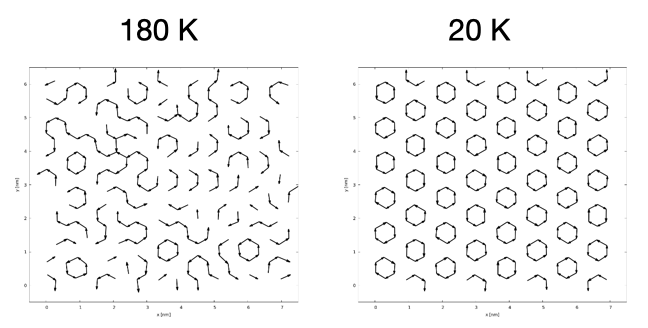
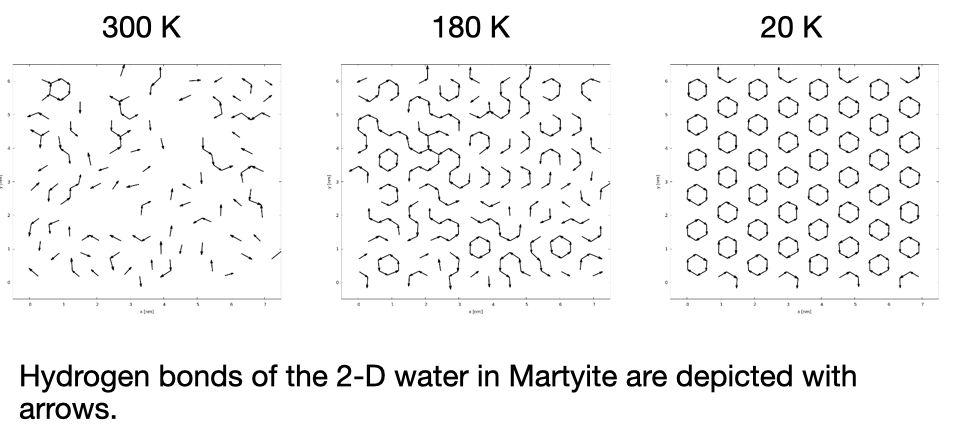
We usually encounter water as a liquid or as solid “ice.” While many types of ice are known, there are also unique collections of water molecules found within minerals, existing in special environments. The mineral “martyite” (chemical formula: Zn₃(V₂O₇)(OH)₂・2H₂O) has a porous framework with a honeycomb-like structure, where water molecules (H₂O) are confined. These water molecules are arranged like “two-dimensional ice,” but at room temperature each molecule rotates freely and does not take a fixed orientation as in ordinary ice.
What is “Ferroaxial Order” in Disordered Water Molecules?
In this study, an experimental team (Shizuoka University and collaborators) and a theoretical team (Okayama University) jointly showed that water molecules in martyite—whose behavior had not been fully explored—in fact possess a special kind of “order” at low temperature. At room temperature the water molecules take random orientations, but under specific conditions six water molecules connect in a ring, forming a toroidal (donut-shaped) H₂O hexamer through “hydrogen bonds” (weak bonds that link water molecules). The phenomenon in which these donut-shaped groups align in a specific direction is called “ferroaxial order.” It is analogous to ferromagnetism, where the north and south poles of magnets line up, but here it is an “axis” that aligns rather than magnetic poles.
Why is the Order of Water Molecules in Minerals Important?
The discovery of this “ferroaxial order” shows that martyite is an ideal model material for studying “two-dimensional ice.” Water molecules are known to form many kinds of ice (polymorphs) depending on temperature and pressure. Beyond everyday ice, many unknown and fascinating forms of ice are thought to exist deep within the Earth and in outer space. This study offers a clue to how water molecules behave and create new kinds of order in the special environment inside minerals. In the long run, it may help unravel the mystery of water’s diverse crystal structures (polymorphism).
Reference Paper
- Nomura, T., Kitou, S., & Koga, K. (2026). “Ferroaxial Order of the Two-Dimensional Water of Crystallization in a Mineral”. Nihon Kessho Gakkaishi, 68, 166. DOI: 10.5940/jcrsj.68.166
- Ferroaxial Order of the Monolayer Ice in Martyite T. Nomura, S. Kitou, J. Komatsu, J. Kimura, K. Koga, et al. Journal American Chemical Society (2026) 148, 10554. DOI:10.1021/jacs.5c19407
Learn more about Prof. Koga → Theoretical Physical Chemistry Laboratory