- Date :01 Mar, 2026
- Category : Inorganic Chemistry
Many of the substances around us can be classified as solid, liquid, or gas. Of these, only solids can hold their shape on their own (sometimes spontaneously) without the help of containers or bags. The structures of solids range from large to small and from simple to complex without limit, and many materials are known to have gaps inside them on the same scale as molecules and ions. In particular, voids on the order of a few nanometers—“nanospace” (one nanometer is one millionth of a millimeter)—cannot be seen by the human eye, yet they hold the potential to transform our lives. For example, activated carbon used in water purifiers and zeolites used as catalysts to break down harmful substances in diesel engine exhaust contain many nanospaces and have the ability to attract odor-causing substances and harmful components. This phenomenon is called “adsorption.” These adsorbent materials are expanding their applications to areas such as removal of radioactive materials from nuclear accidents and removal of carbon dioxide in space stations. Metal-organic frameworks (MOFs), which were the subject of the 2025 Nobel Prize in Chemistry, are also nanospace materials; some of them exhibit properties never seen in conventional adsorbents, such as sponge-like changes in solid structure upon gas adsorption.
Is Nanospace Made of Carbon Special?
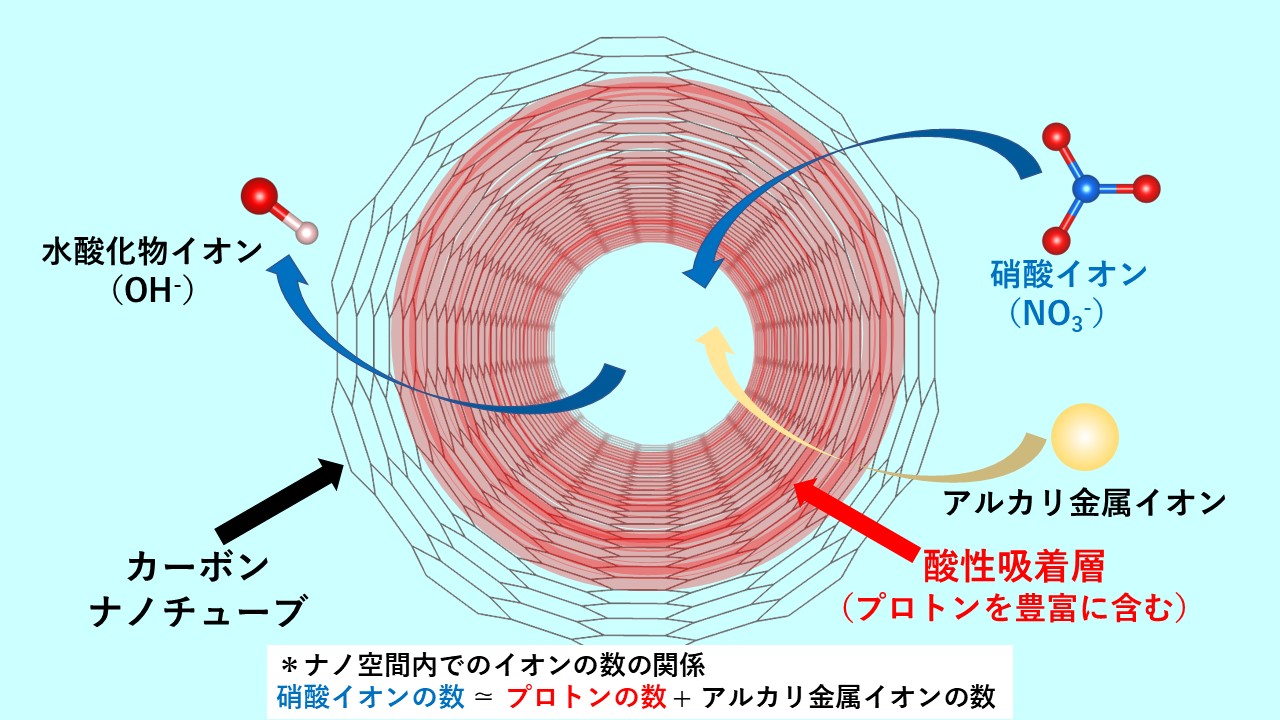
The surfaces of activated carbon and carbon nanotubes have a structure in which hexagonal arrays of carbon atom units are linked. On this surface, electrons (called π-electrons) move freely and strongly attract and stabilize positively charged species. When these materials are placed in an aqueous solution containing electrolytes, it was found that water quickly diffuses into the nanospace while forming an adsorbed layer of hydrogen ions on the surface. Normally, water is slightly ionized (dissociating into hydrogen ions and hydroxide ions). Hydrogen ions are thought to adsorb selectively on the carbon surface, creating an extremely acidic environment. On the other hand, the excess hydroxide ions diffuse outward while exchanging with anions outside the nanospace, so the solution outside the nanospace becomes basic (alkaline). Nanospace made of carbon is truly a unique space.
The Possibilities of Nanospace Are Endless!
There are many other phenomena that cannot be seen in flasks or test tubes: chemical reactions that occur only in nanospace, or states that are normally only observed under extremely high pressures—difficult to achieve in conventional experiments—that can be created easily. So by freeing ourselves from preconceptions and elucidating the invisible world through both experiment and computation, there is great potential to discover reactions and properties that humanity has yet to know. In the extremely confined space of nanospace, the possibilities are infinite.
- Okayama University Press Release
- Takahiro Ohkubo, Hiroki Nakayasu, Yuki Takeuchi, Nobuyuki Takeyasu, Yasushige Kuroda, “Acidic layer-enhanced nanoconfinement of anions in cylindrical pore of single-walled carbon nanotube”, Journal of Colloid and Interface Science 629, 238 (2023). DOI:10.1016/j.jcis.2022.09.070
Want to know more about Prof. Ohkubo’s research!→Inorganic Chemistry Laboratory