- Date :01 Feb, 2026
- Category : Organic Chemistry
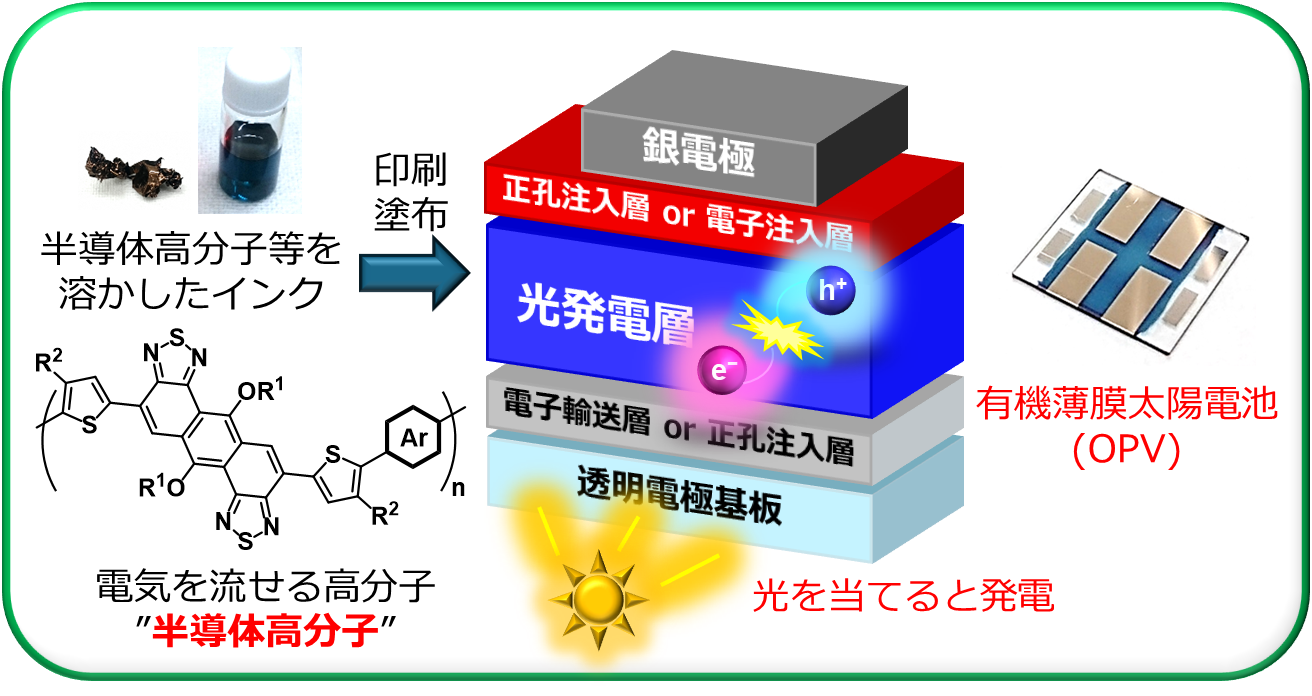
Polymers represented by rubber and plastics generally have insulating properties, meaning they do not conduct electricity. By introducing a conjugated structure, in which single and double bonds alternate, into the polymer structure, we obtain semiconducting polymers—polymers (plastics) that can conduct electricity despite being polymers. These semiconducting polymers not only have the ability to conduct electricity but also strongly absorb sunlight. By mixing them with other organic semiconductor materials, dissolving them in organic solvents to create an ink, forming a thin film through methods such as printing and coating, and then sandwiching it between two electrodes, we can create flexible solar cells using organic materials, known as organic photovoltaics (OPV).
Organic photovoltaics (OPV) are composed of soft organic materials (polymers), offering advantages such as the ability to manufacture lightweight and flexible solar cells over large areas at lower cost. As such, they are expected to serve as next-generation solar cells that could replace silicon solar cells currently used in solar panels.
The Functional Organic Chemistry Laboratory skillfully utilizes the properties of organometallic complexes composed of metals and organic compounds to develop novel carbon-carbon bond-forming reactions that form the foundation of organic synthetic reactions. Additionally, by leveraging these organic synthetic reactions, we aim to develop new high-performance semiconducting polymer materials for the practical application of organic photovoltaics (OPV).
Want to know more about Prof. Mori’s research!→Functional Organic Chemistry Laboratory