- Date :01 Feb, 2026
- Category : Physical Chemistry
Our bodies and the materials around us are made up of a very tiny world. This size is called a “nanometer,” which is about one hundred-thousandth the thickness of a human hair. In this nanoscale world, even the tiniest differences can dramatically change the properties of materials and how life works. At the Nanochemistry Laboratory, we’re researching ultra-high-quality nanodiamonds as materials to accurately investigate the nanoscale world.
What are Ultra-High-Quality Nanodiamonds?
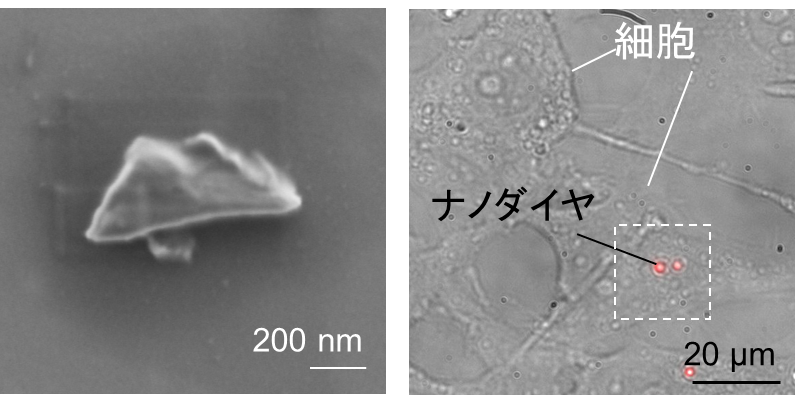
Diamonds are known as super hard gemstones, but they actually have glowing properties too! When nitrogen atoms and defects (vacancies) that are barely present in diamonds end up next to each other, they emit red light when you shine green light on them. We’re working on creating “ultra-high-quality nanodiamonds” that can measure temperature more accurately than ever before by controlling the impurities and structures inside diamonds.
Nano Sensors That Measure Tiny Changes
Ultra-high-quality nanodiamonds aren’t just glowing—they can be used as nano-sized sensors that detect changes in temperature and the surrounding environment. For example, you can use nanodiamonds to investigate tiny temperature changes happening inside cells or environmental changes that come with chemical reactions. A cell is about 20 micrometers in size (about one-fifth the thickness of a hair), and there’s no thermometer that fits inside.
From Nano Materials to New Measurement Technologies
In the nanoscale world, making “good materials” directly leads to “good measurements.” At the Nanochemistry Laboratory, we’re exploring chemistry that maximizes the power of nanodiamonds through material synthesis and surface engineering. This research is expected to find applications in various fields like life sciences, medicine, and environmental monitoring.
This Might Be for You If…
- You’re interested in the tiny world and nano materials
- You get excited about “scientific diamonds” that aren’t gemstones
- You want to try making new tools using chemistry
- You’re also a bit interested in physics and biology
Keywords
Nanodiamond / Ultra-High-Quality Materials / Nano Sensor / Temperature Measurement / Quantum Properties
- Okayama University Press Release
- Keisuke Oshimi, Hitoshi Ishiwata, Hiromu Nakashima, Sara Mandić, Hina Kobayashi, Minori Teramoto, Hirokazu Tsuji, Yoshiki Nishibayashi, Yutaka Shikano, Toshu An, Masazumi Fujiwara, “Bright quantum-grade fluorescent nanodiamonds”, ACS Nano 18, 35202 (2024). DOI: 10.1021/acsnano.4c03424
Want to know more about Prof. Fujiwara’s research!→Nanochemistry Laboratory