- Date :08 Jan, 2026
- Category : Analytical Chemistry
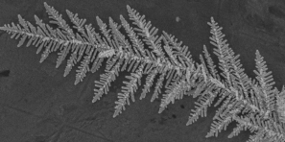
When silver ions are reduced under well-controlled conditions, silver dendritic structures grow in the solution, as shown in the figure (left). These structures closely resemble real trees, with branches extending from a trunk and finer twigs bifurcating from those branches. It is a fascinating phenomenon that such complex structures are formed naturally.
The size of these silver dendritic structures is approximately 10 to 100 micrometers, which cannot be observed with the naked eye. However, using an optical microscope, the branching patterns can be clearly seen. The structure becomes finer towards the tips, where numerous extremely small protrusions of about 20 to 30 nanometers exist (1 nanometer is one-billionth of a meter). These protrusions can only be observed using an electron microscope.
Silver dendritic structures possess intriguing optical properties. The figure (right) shows a photograph taken with a dark-field optical microscope. In dark-field microscopy, only substances that strongly scatter light appear bright, while the surroundings remain dark. When observed this way, many bright spots of various colors, such as red, green, orange, and blue, are visible within the silver dendritic structure.
This is because light is strongly concentrated at the nano-sized protrusions at the tips of the dendritic structure. Slight differences in the shape and size of the protrusions lead to differences in the color (wavelength) of the collected light, resulting in the observation of a variety of colors. Consequently, silver dendritic structures respond strongly not only to visible light but also to a wide range of wavelengths, including near-infrared light, which is invisible to the human eye.
Our research group investigates how silver grows into dendritic shapes and studies the optical properties and functions unique to these shapes. Dendritic structures are also characterized by their extremely large surface area. Recently, we have also been conducting research on gold dendritic structures. These noble metal dendritic structures are expected to find applications in light-based sensors and new optical materials and devices.
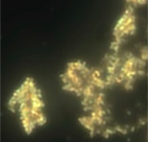
Electron microscope image (left) and dark-field optical microscope image (right) of silver dendritic structures.
Learn more about Prof. Takeyasu’s research! → Analytical Chemistry Laboratory