- Date :01 Dec, 2025
- Category : Organic Chemistry
Economic and Environmental Problems Caused by Fouling Organisms
Fouling organisms, including barnacles, are marine organisms that attach to ship hulls and coastal power plant facilities, causing significant damage to the marine industry.
- Impact on vessels: When barnacles attach to ship hulls, water resistance increases significantly, drastically worsening fuel efficiency. This leads to serious economic losses.
- Impact on power plants: Attachment to seawater intake pipelines causes decreased efficiency in heat exchange and cooling systems.
- Impact on fishing nets: Attachment blocks net openings, leading to oxygen deficiency in fish and damage to fish surfaces, resulting in reduced catch. Additionally, increased weight of fishing nets impedes the work of fishing industry personnel.
Preventing damage caused by these fouling organisms is one of the important global social challenges that must be addressed.
The Need for New Antifouling Agents
Many currently used antifouling agents possess toxicity to organisms, and their adverse effects on the marine environment have been reported and are of concern. Therefore, there is a strong demand for the development of safe, environmentally friendly new antifouling agents that are effective while minimizing impact on organisms and the environment.
Discovery and Evaluation of Xylemin
Barnacles search for attachment sites at the cypris larva stage, and once they attach, they spend their entire lives at that location. Disrupting this attachment and metamorphosis process is the key to new antifouling technology.
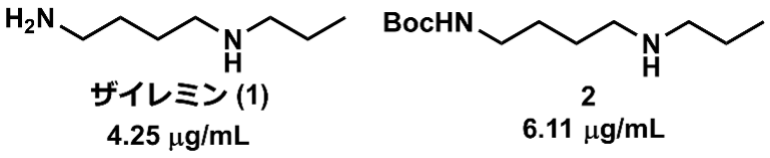
Our research group focused on xylemin and its related compounds and evaluated their antifouling effects and toxicity against cypris larvae of the barnacle Amphibalanus amphitrite.
It has become clear that xylemin and its related compounds effectively inhibit barnacle attachment at very low concentrations and show no toxicity to organisms.
Future Prospects
This discovery represents a major step forward in the development of revolutionary antifouling agents with low environmental impact that inhibit attachment without killing organisms.
In the future, using xylemin and its related compounds, it is expected that effective, safe, and environmentally friendly new antifouling coatings will be developed, contributing to the sustainable development of the marine industry.
- Okayama University Press Release
- Takamura, H., Yorisue, T., Tanaka, K. & Kadota, I. Antifouling activity of xylemin, its structural analogs, and related polyamines. Chem. Biodivers. 22, e202403213 (2025). DOI:10.1002/cbdv.202403213
Want to know more about Prof. Takamura’s research!→Organic Chemistry Laboratory